


An Associated Press report landed before federal officials announced that Immigration and Customs Enforcement was supposedly drawing down operations in Minnesota. That timing is important, because what the AP article documents isn’t some isolated misunderstanding. It’s a pattern of behavior that reads less like routine law enforcement and more like a field manual for intimidation.
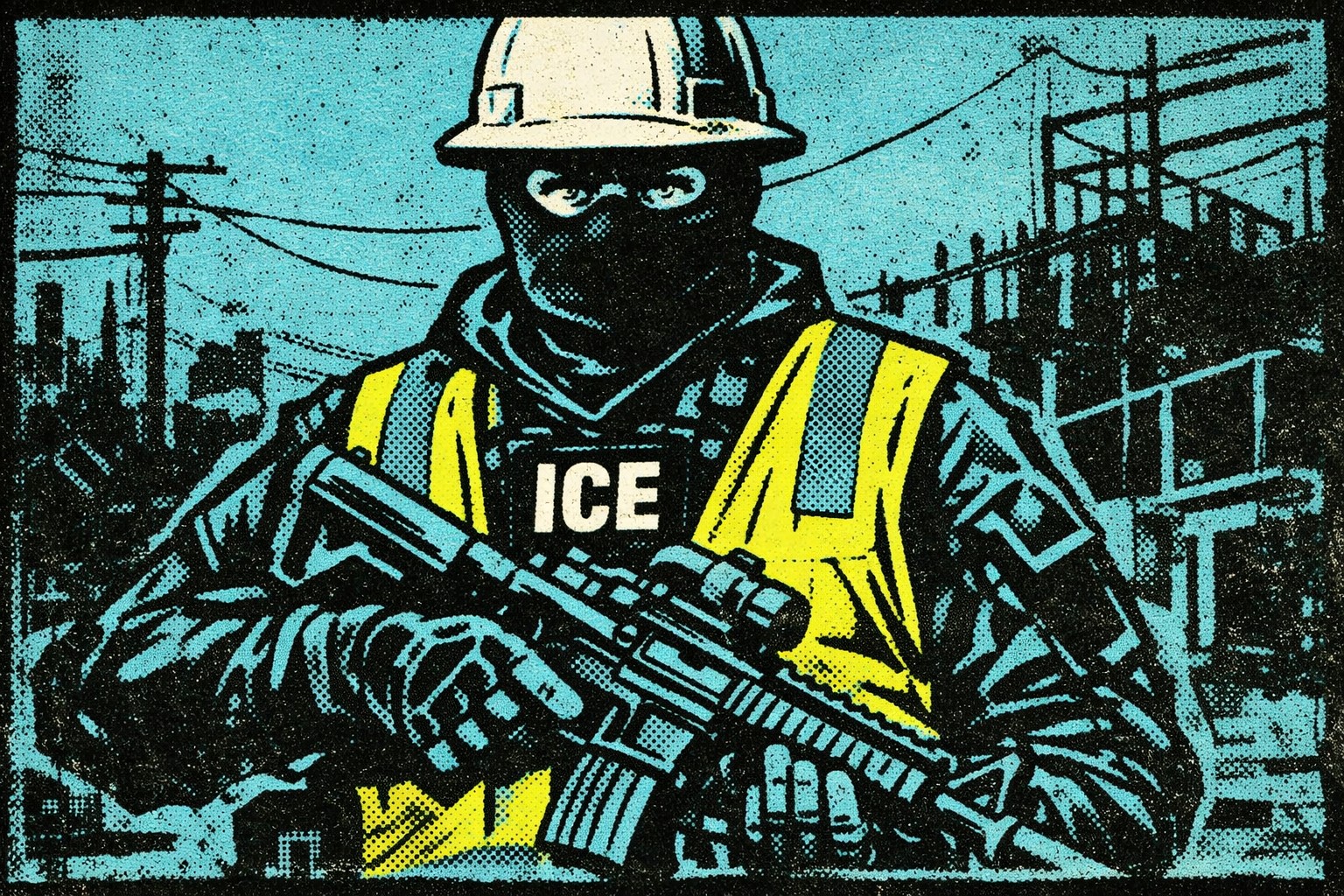
According to the AP, a local resident noticed men dressed as utility workers staking out his family’s restaurant in suburban Minneapolis. The men wore pristine white hard hats. High-visibility vests. They stayed in their vehicle while “working.” The electrician company advertised on the doors didn’t exist.
When the same vehicle came back days later, the witness confronted them on camera. The men pulled their faces away. Under the safety vests, the witness says, they appeared to be wearing tactical gear.
That’s not a coincidence. That’s theater.
A spokesperson for the Department of Homeland Security and Immigration and Customs Enforcement declined to confirm whether the men were federal agents. But legal observers and activists across Minnesota told AP they’ve seen a growing number of similar encounters: agents dressed as construction workers, delivery drivers, and even anti-ICE activists. Vehicles with fake or swapped plates. Pickups loaded with tools to sell the disguise.
At the Bishop Henry Whipple Federal Building, the central hub of ICE activity in the city, observers reported agents leaving with stuffed animals on dashboards, Mexican flag decals on bumpers, and construction-themed props. Optics designed to blend in. To misdirect.
This is not normal policing.
ICE has always used “ruses.” They admit it. Attorneys have been fighting it for years. During Trump’s first term, the American Civil Liberties Union sued over agents posing as local police to gain entry into homes. A settlement eventually restricted that practice in Los Angeles.
Elsewhere? Still legal.
But what’s happening in Minnesota goes beyond knocking on doors under false pretenses.
This is open-air surveillance using costumes.
Construction sites are suddenly visited by “workers” who don’t know the trade. An antiques dealer says men came into her shop asking for modern license plates. When she stepped outside, she spotted an idling SUV with blacked-out windows. She later matched the plate to a vehicle repeatedly photographed leaving the Whipple building and tied to an earlier immigration arrest.
That’s not subtle. That’s operational camouflage.
Even Governor Tim Walz said agents appeared to be swapping plates, something that violates state law. Activists describe a volunteer network scrambling to track vehicles, warn communities, and document what they’re seeing in real time.
And in response?
ICE adapted.
High-vis vests. Fake work trucks. Decals. Props.
This isn’t about officer safety anymore. It’s about avoiding public accountability.
People throw around the term “secret police” casually. This isn’t casual.
Secret police aren’t defined by whether they carry badges. They’re defined by behavior.
They hide their identity. They operate outside transparent oversight. They blend into civilian life to monitor and intimidate targeted communities. They create fear not just among suspects, but among everyone nearby.
That’s exactly what AP describes.
When restaurant owners start questioning electricians. When residents hesitate to open doors for delivery drivers. When construction workers have to prove they’re real. That’s the social damage secret policing causes.
The ACLU put it bluntly in the article. If people start wondering whether the electrical worker outside their house might be ICE, you’re inviting dangerous confusion and distrust. That’s not professional law enforcement. That’s population control.
This is what authoritarian systems look like at street level.
Not stormtroopers. Not checkpoints.
High-visibility vests in parking lots.
You’ll hear the bootlickers say, “Police go undercover all the time”.
True. But that comparison collapses under scrutiny.
Traditional undercover work is targeted and investigative. It’s designed to penetrate criminal organizations, gather evidence, and build prosecutable cases. It involves carefully supervised operations, specific suspects, and defined objectives.
What ICE is doing here is fundamentally different.
These aren’t long-term undercover officers embedded in drug rings. These are agents dressing up as utility workers to loiter outside immigrant businesses.
They’re not infiltrating criminal enterprises. They’re surveilling entire communities. Undercover police aim to uncover crimes. This aims to make people afraid to exist in public.
There’s also a critical legal distinction. Undercover cops still operate within clearly defined jurisdictional rules and identification protocols once an arrest is made. They don’t typically swap plates, impersonate multiple professions in broad daylight, or deploy props to confuse civilian observers.
ICE’s approach here is ambient deception. It doesn’t just target individuals. It destabilizes trust across whole neighborhoods.
That’s the difference.
Local immigration activists told the AP that real construction workers can tell immediately when someone is faking it. But the rest of the public can’t. So everyone becomes suspicious. Everyone becomes hyper-vigilant.
One witness described stopping a locksmith days later because he feared the man might be a federal agent. Only afterward did he realize it was just a local worker doing his job.
That’s what this creates.
A society where ordinary interactions feel like potential traps.
Supporters of the crackdown argue that activist networks forced ICE to adapt. A former enforcement official claimed he’d never seen this level of “interference.”
That framing is revealing, as transparency is now treated as obstruction. Community observation is framed as sabotage. Public accountability becomes the enemy.
All of this unfolded before federal officials announced that ICE was supposedly pulling back from Minnesota.
Which raises an obvious question.
If these were the tactics before the drawdown, what exactly does “leaving” mean?
Because secret police don’t vanish. They just change outfits.
This isn’t about immigration policy debates. You can support enforcement and still recognize when enforcement crosses into something darker.
When agents hide behind construction vests. When license plates get swapped. When communities can’t tell workers from agents.
That’s not routine law enforcement. That’s a security apparatus operating in the shadows, testing how much fear it can inject into everyday life.
And once that line is crossed, it’s never just about immigrants anymore.
It’s about what kind of country decides this is acceptable.
(Source)
Leave a Reply