


This past Monday, three middle schoolers were arrested after authorities say they were planning a mass shooting at Clinton Middle School in Oneida County, New York. The suspects are two girls and a boy between the ages of 13 and 14 who have not been named due to their juvenile status.
The target was the cafeteria during lunch. If that sounds familiar, we’ll get to that in a minute. But police say they had the means to carry it out, and based on what came out in court documents, that’s not an exaggeration.
The plot unraveled after a parent of some other student saw threatening messages on Snapchat and called 911 in the early morning hours. From there, law enforcement moved quickly, tracking down the teens, interviewing them, and getting them into custody before the plan could get anywhere close to becoming reality.
The 14-year-old girl appears to have been the driving force behind the plot. Investigators say she had become obsessed with the Columbine High School massacre and the Sandy Hook Elementary School shooting. She was writing about wanting to kill everyone in the school and be remembered for it.
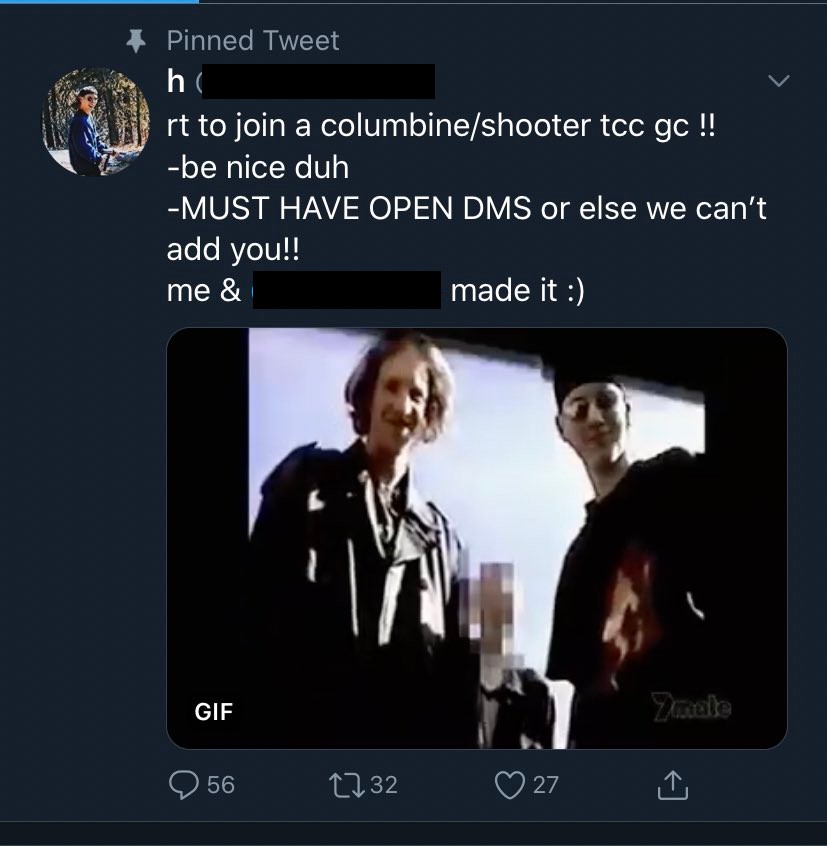
When you see that combination of fixation and intent, you’re not just dealing with a kid who’s read too many headlines. You’re looking at what’s commonly referred to as Columbiners. That’s the subculture of people who idolize the Columbine shooters, sometimes to the point of seeing them as role models instead of mass murderers. It overlaps heavily with parts of the so-called True Crime Community, not your wine moms who watch Dateline, but the fringe teens who romanticize killers, trade in their writings, and turn real-world violence into something to emulate. It’s been around for decades, long before social media made it easier to find each other, and it keeps showing up in cases like this.
The 14-year-old girl also reportedly talked about bullies and wanting them to feel her pain. That’s another familiar piece of the Columbiner script. The myth that the Columbine shooters were just bullied kids who snapped has been debunked over and over again, but it refuses to die. It gets recycled in these circles because it offers a kind of justification, a way to frame mass violence as revenge instead of what it actually is. When you see a kid repeating that narrative, it’s usually not because they independently reached that conclusion. It’s because they’ve been soaking in online content that pushes it.
Then there’s the influence of the movie Zero Day, which shows up again like it has been lately. For anyone who doesn’t know, Zero Day is a 2003 film shot in a pseudo-documentary style that follows two teenagers as they plan a school shooting. It was meant as a critique, but over the years it’s been adopted by the exact kind of people it was supposed to warn about. In this case, the group chat used by the teens was named after a character from the film.
This plot wasn’t just idle talk, either. The 14-year-old girl allegedly intended to get guns from the 13-year-old boy, who knew what she was planning and offered to supply them. Deputies ended up seizing eleven firearms from his mother’s safe. Who in the blue hell needs eleven guns in a house with a teenager? After that, you have to ask the more important one. How secure was that safe, really? I’ve written too many of these stories where the answer turns out to be “not very.” Kids figure out combinations, they find keys, or the safe just isn’t as locked down as the adults think it is. When teenagers want to get their hands on something ‘forbidden,’ they become the most innovative engineers you’ve ever seen.
Another layer to this story was a mutual suicide pact between the two girls, which is another pattern that shows up in these cases. The violence is the statement, and the suicide is the final act. Again, emulating the cowards from Columbine.
There was also a fourth boy in the orbit of all this. He wasn’t charged, but deputies still took about thirty firearms from his home out of caution. Thirty. Again, who needs thirty guns, especially in a household connected to teenagers who are even tangentially involved in something like this? Law enforcement says those weapons were legal, and that may be true, but legality doesn’t equal safety.
In the end, the only reason this didn’t turn into another headline about a school shooting is because one parent saw something and acted on it. Everything else was already in place. The plan, the influence, and the access to weapons.
The Oneida County Sheriff summed it up in the simplest way possible, and it’s hard to argue with him. Parents need to be parents.
(Sources)



Leave a Reply