


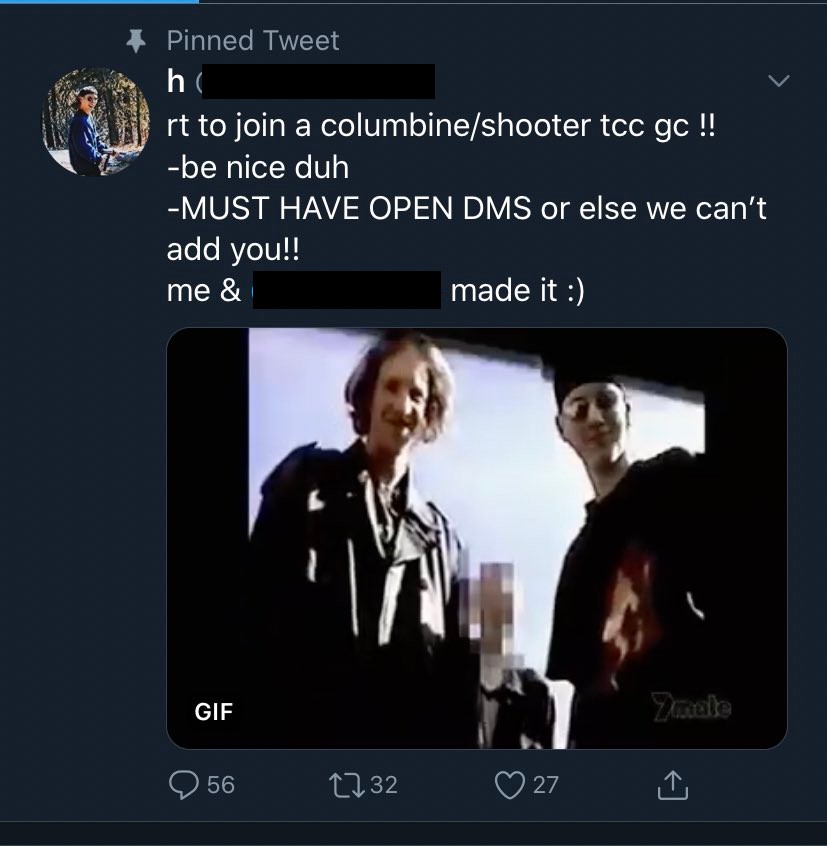
For more than 26 years, I’ve been writing about Columbiners. Back when most people had never heard the term, there were already online communities devoted to obsessing over the cowardly killers of Columbine. Over the years, I’ve watched those communities evolve, migrate from platform to platform, develop their own language, and attract new generations of followers who weren’t even born when the 1999 shooting happened.
For too long, too many people dismissed these groups as harmless fandoms, edgy teenagers, or just another strange corner of the internet. Yet the same themes kept appearing over and over again. There was the idolization of killers, the collection of photos, videos, manifestos, and personal writings and the tendency to turn mass murderers into celebrities. Most concerning of all, there were always individuals who seemed less interested in studying these attackers and more interested in becoming them.
Over many years, I’ve written repeatedly about how Columbiner culture has expanded beyond its original focus. What started as a fascination with the Columbine cowards of Eric Harris and Dylan Klebold has become something much larger. Today’s mutant spaces, as Iused to call them, often celebrate a wide range of mass killers, school shooters, terrorists, and other violent offenders. The labels may have changed, but the underlying obsession remains the same.
Well, if you won’t listen to me after more than two decades of covering this subject, maybe you’ll listen to the Anti-Defamation League.
The ADL recently released an extensive report on what it calls the True Crime Community, or TCC. The ADL isn’t some random advocacy group that just appeared yesterday. Founded in 1913, the ADL has spent more than a century tracking antisemitism, hate groups, extremism, and other forms of radicalization. The organization has developed considerable expertise when it comes to monitoring hateful online activity and extremist networks.
Their new report is one of the most detailed examinations I’ve seen of the culture surrounding mass killers and the online communities that glorify them. In many ways, it confirms concerns that I have been raising for years.
One of the most interesting points in the report is that the ADL does not define the True Crime Community as an ideological movement. Instead, it describes a subculture built around fascination with violence, mass murder, notoriety, and misanthropy. In other words, members are not necessarily united by a specific political belief. What often connects them is an attraction to the violence itself.
This explaisn why some of these communities can simultaneously glorify attackers whose motivations completely contradict one another. The report notes that white supremacists, Islamist attackers, school shooters, and other mass killers may all be celebrated side by side. The ideology frequently becomes secondary to the body count, the spectacle, and the infamy.
Another point worth noting is the age of many TCC adherents. According to the ADL, much of the community is made up of teenagers and young adults. Researchers even observed some users who were reportedly younger than 14 years old participating in these spaces. That should concern anyone, especially parents, who cares about the influence social media and online communities can have on young people who may already be struggling with isolation, depression, anger, or other personal issues.
The report also spends considerable time discussing how newer technologies are changing the landscape. Artificial intelligence is now being used to create videos, images, and other content featuring notorious killers. Some of these productions are presented as jokes, while others romanticize or humanize mass murderers in ways that would have been far more difficult just a few years ago. The result is a steady stream of content that can make these figures seem less like criminals and more like internet celebrities.
Gaming platforms receive significant attention as well. According to the report, users have recreated famous mass shootings inside popular games, like Roblox, complete with maps, clothing, weapons, and other details designed to mimic real-world attacks. While many people think of gaming as simple entertainment, the ADL argues that these recreations can serve as another avenue for glorifying violence and preserving the legacy of previous attackers.
The report also highlights the role of gore forums where users share and discuss videos and images of real-world death and violence. For years, researchers and journalists have documented how some future attackers spent time in these environments. Exposure alone does not turn someone into a killer, but repeatedly immersing vulnerable individuals in communities that normalize violence is clearly not a healthy combination.
Another interesting takeaway from the ADL’s research is that most people involved in these communities never commit acts of violence. The overwhelming majority of participants will never carry out an attack. At the same time, the report argues that these spaces can provide inspiration, validation, and social reinforcement for the small number of individuals who are already moving in a dangerous direction.
The problem is that when someone who is already troubled enters an environment where mass killers are admired, discussed endlessly, and treated like celebrities, the results can be catastrophic.
The ADL report is long, but I strongly encourage readers to take the time to read it. It provides one of the clearest looks yet at how Columbiner culture has evolved into something much broader. What once revolved around a single school shooting has grown into a sprawling online ecosystem centered on fascination with violence itself.
To me, very little of this comes as a surprise. What’s different now is that one of the nation’s most prominent organizations focused on extremism has put many of these concerns into a comprehensive report. Hopefully, more people will start paying attention.
(Source)

Leave a Reply