


When I first wrote about the school shooting at San Jose National High School in Tacloban City, Philippines, I said I had a hard time believing this was simply another case of two bullied kids. Even in those first few days, there were details that did not fit that narrative, as they rarely ever do. The reported planning, the choice of weapons, the number of rounds fired, and the fact that innocent students were among those killed all suggested something much more deliberate.
Since then, the investigation has continued to unfold, and I think it has moved much closer to confirming what I suspected from the beginning.
The two suspects, ages 14 and 15, remain in government custody. Philippine authorities have given the 14-year-old the alias “Nash” because he is a minor. (Does that make the other kid “Hall”?)
Investigators now believe the shooting was planned well in advance, and lawmakers have spent the past week trying to piece together how two teenagers reached the point where they walked into their school armed with stolen guns and murdered three classmates while injuring many others.
One of the biggest questions has been the 9mm Glock used by Nash. The pistol belonged to his aunt, a police officer who has since been relieved of duty and is facing administrative proceedings over how her government-issued firearm ended up in her nephew’s hands.
During a Philippine Senate hearing, Nash’s aunt testified that her nephew had always looked up to her and wanted to become a police officer. According to her testimony, he asked her to take him to a firing range because he wanted to become a cop, and she agreed. She also said she only brought him there once.
That makes me wonder if she had been manipulated from the very start.
If Nash had already been planning this attack, pretending to admire his aunt’s profession and expressing an interest in becoming a cop would have been a convenient way to gain access to guns and learn how to use them without raising suspicion. I obviously can’t say that is what happened, but it is difficult not to ask whether she was tricked into teaching him skills he intended to use for something unimaginably different. What appears to have been an innocent request from a teenager may eventually prove to have been part of a much darker plan. Sadly, he wouldn’t be the first kid in the past few years who convinced an adult to provide them a gun.
The Philippine Senate hearing also focused on how the gun was stored. Nash’s aunt testified that she believed the pistol was secured inside a locked gun box that was kept inside a locked plastic cabinet in her home. Senators questioned why the weapon was not stored inside a proper gun safe as required by police procedures.
Again, we’ve seen a generation of kids recently who have become little safecrackers to get their hands on an adult’s gun. In reality, what I think has really happened is that American adults have never properly secured their guns. But now, a nihilist group of kids that continues to grow wants to get a hold of those barely secured weapons, but I digress.
But what also has caught my attention is how the discussion surrounding the motive has changed.
When the shooting first happened, the explanation centered almost entirely on bullying. As I said in my previous posts, I thought that explanation was far too simplistic. School shootings almost always involve far more than one perceived grievance, and history has shown us that many attackers who claim they were bullied were just Columbine copycats.
Now, Philippine investigators seem to be arriving at a similar conclusion.
In a previous post, I wrote about photographs that appeared to show one of the suspects wearing a KMFDM shirt. I pointed out that KMFDM has long been associated with the Columbine shooters, not because the band bears any responsibility for what happened, but because some Columbine obsessives and copycats have adopted the band’s imagery over the years as a reference to that attack. I also made it clear that a t-shirt alone proves nothing.
Now investigators themselves have publicly acknowledged they are examining whether previous school shootings abroad influenced one of the suspects. They specifically mentioned the reported KMFDM shirt as one of the reasons they are looking at that possibility.
That also brings me back to something else I wrote after the shooting. I described the attack as what I called an “American import.” Unfortunately, I think that description has come very close to being confirmed.
Investigators and lawmakers are now openly discussing the possibility that the suspects were influenced by the online extremist network known as 764. The FBI has also identified 764 as a significant violent extremist threat because of its alleged involvement in coercing vulnerable young people into self-harm, animal abuse, sexual exploitation, and acts of violence. Then again, the FBI once called Juggalos a gang. Anyway, Philippine investigators believe the Tacloban suspects may have been exposed to that same supposed group.
I have a hard time believing 764 is a thing. Anybody sitting behind a keyboard can claim to be part of “764.” They sound more like a 4chan prank that got out of hand. I am skeptical whenever people describe it as though it operates like some secret society.
What I do believe is real is the larger online culture surrounding it.
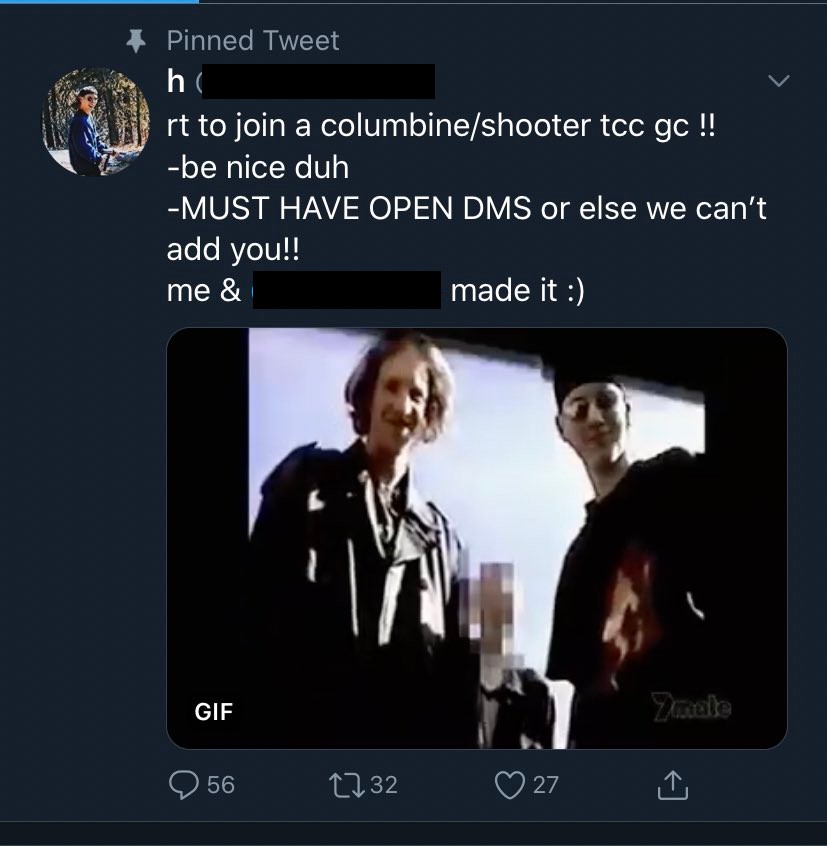
Philippine investigators have described 764 as one part of what they call the True Crime Community, alongside other online subcultures. In my opinion, that makes much more sense. I have spent years watching Columbiners operate online. They obsess over previous mass murderers, collect photographs and videos, analyze attacks in disturbing detail, and sometimes encourage one another’s darkest fantasies. Whether someone calls themselves a Columbiner, claims to belong to 764, or identifies with some other label almost becomes beside the point. They are all participating in the same poisonous online culture.
That culture wasn’t native to the Philippines.
It was exported there.
For decades, the United States has produced a steady stream of school shootings that have become infamous around the world. Thanks to the internet, the communities that romanticize those crimes no longer stop at America’s borders. A teenager sitting in Tacloban can now stumble into the same online spaces that a teenager in Colorado, Florida, or Texas can find. That is why I continue to believe this was an American import, not because Americans committed the shooting, but because the culture surrounding these attacks has spread internationally like some kind of cancer.
Investigators also believe online games may have been one of the places where the shooters were first approached by groomers. I have no interest in blaming games for what happened. Millions of kids play video games every day without becoming violent. The real danger is who may be waiting inside those online games.
Predators know lonely kids spend hours online. They know how to identify children who seem isolated. They know how to become friends before gradually introducing increasingly disturbing material and pulling those children deeper into extremist communities. The game itself is simply the meeting place. The people doing the grooming are the real threat.
Predators, whether ‘traditional’ or nihilists, know lonely kids spend hours online. They know how to identify children who seem isolated. They know how to become friends before gradually introducing increasingly disturbing material and pulling those children deeper into extremist communities. The game itself is simply the meeting place. The people doing the grooming are the real threat.
This was never a story about bullying. It’s a story about online radicalization, access to guns, and a school shooting culture that originated in the United States before finding its way halfway around the world. Once those ideas crossed borders, they became much harder to contain.
(Sources)
- Possible influence of shootings abroad among leads in Tacloban incident
- 14-year-old Tacloban shooting suspect wanted to be a cop – aunt
- Tacloban shooting may be first ‘completed’ attack by 764 extremist network — expert
- 24 minors rescued from extremist group True Crime Community
- Tacloban school shooters may have been ‘groomed’


Leave a Reply