


I don’t write about Australia very often, and the reason is pretty simple. After the Port Arthur massacre in 1996, their government did something about guns, which isn’t a sentence I ever get to type about my own country.
Guns aren’t banned there, and plenty of Australians own them, but they’re licensed and registered, and they’re nowhere near as prolific as they are in the states. Fewer guns mean fewer shootings, and fewer shootings mean less for me to write about. But time and technology march on, and a story out of the Northern Territory this week has me wondering how long that calm can last.
Police in the NT arrested a teenager who can’t be named because of his age, and the investigation started with a Crime Stoppers tip that came in just last week.
Officers searched his home and seized devices and documents, and the Joint Counter Terrorism Team says they contained violent extremist material and references to violent attacks. Sources told the ABC that he had allegedly voiced admiration for the Columbine massacre and for Brenton Tarrant, the white supremacist who murdered 51 people at two mosques in Christchurch, New Zealand in 2019. Police also said the material pointed to a mixed ideological motivation, with glorification of a mass-casualty attack at a school or a place of worship.
Investigators found instructional schematics for 3D-printed firearms on his devices too, and he now faces three charges, including collecting documents likely to facilitate a terrorist act and possessing firearms and explosive manufacturing material.
To be fair, police say there’s currently no information that he had access to firearms or the ability to make one, and the NT police commissioner says there’s no ongoing threat to the community. The judge wasn’t treating it like a teenage daydream, though, saying plainly that it was “not a mere fantasy.” He was remanded in custody and is due back in court on November 9th.
Notice the pairing of Columbine and Christchurch. A 1999 high school massacre and a white supremacist’s livestreamed mosque attack have nothing in common ideologically. However, while the article never uses the term, this is classic behavior from what’s become known as the so-called True Crime Community.
The Australian Federal Police recently analyzed 55 radicalized kids and found they were all male, all radicalized at least partly online, and mostly carried scattered, fragmented ideologies. These kids aren’t picking a cause so much as picking a pantheon.
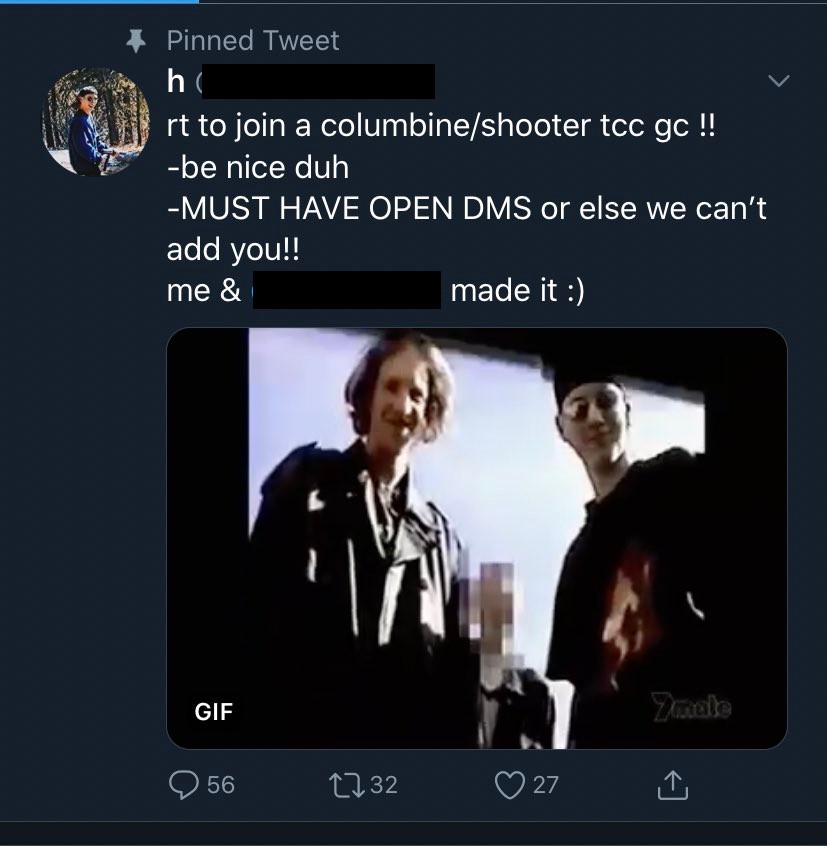
If you’ve never heard of the TCC, don’t confuse it with people who binge murder podcasts on a Sunday afternoon. It’s a loose online network that started as fandom around notorious killers and curdled into something much darker, where mass shooters get treated like celebrities. Members trade edits and memes about them, rank them like trading cards, and egg each other on, and in the worst corners they recruit new people to carry out the next attack.
Then there’s the matter of 3D-printed guns. A 3D printer melts plastic filament and lays it down layer by layer to build an object from a digital file, and people have worked out how to do that with gun parts. The files get passed around online for free, so anyone with a printer that costs a few hundred bucks and some patience can make parts without a store, a background check, or a registry. It isn’t push-button easy, and the results can be unreliable, but the trend lines are ugly.
The NYPD went from finding one 3D-printed gun among 263 recovered ghost guns in 2021 to 109 out of 409 in 2024, and the Australian government would be foolish to assume their country is immune.
For Australia, this is a particular kind of problem. Their whole system works by controlling the chokepoint. You need a license, a genuine reason, a registration, and a legal sale, and that’s what keeps the gap between wanting a gun and having one so wide.
A printer sidesteps nearly all of it. I’m not saying this kid could have pulled it off, because police say there’s no evidence he could, but a teenager who would never pass a licensing check might not need to. And as I’ve argued before, the supposed fix of making printers block gun files is mostly wishful thinking, so I don’t have a tidy solution to this problem.
I haven’t had to write about a school shooting in Australia, and I’d love to keep it that way. But we used to not hear about school shootings in the Philippines either.
Nobody thinks it can happen to them until it does.
(Source)


Leave a Reply